
5 Lessons from the Bloomberg Digital Accelerator Program
Updated: Aug 7

Five years ago I got a phone call. “Ian, we’re putting a team together.”
No, it wasn’t Nick Fury forming the Avengers. But it wasn’t far off. It was Owen Hopkin, now Director of New Technologies and Innovation at Arts Council England. He continued: “We’ve got this new funding programme with Bloomberg for cultural institutions. It’s big. It’s going to be different. We don’t know how it’s going to go. Are you in?” Or something to that effect.
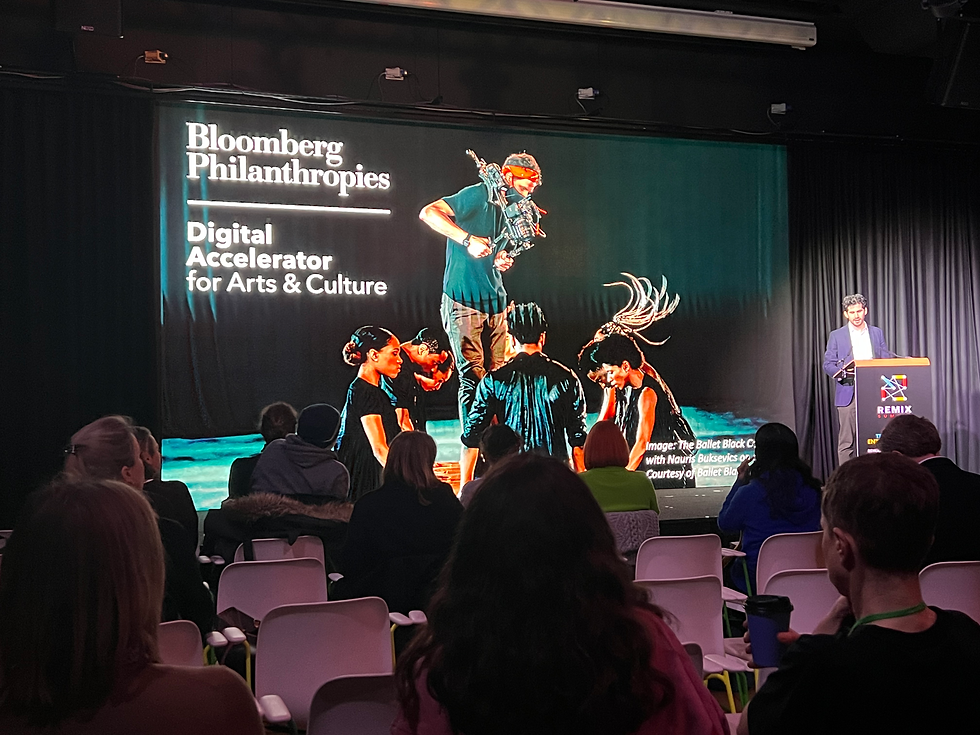
Perhaps it was the honesty. Perhaps it was the pandemic. Perhaps just my curiosity. Either way, I said yes immediately and set out on an unexpected journey as an advisor to the funded organisations on the Bloomberg Digital Accelerator Programme.
Five years later, after 10 projects delivered, 10 organisations supported, 10 fellows advised, and over £2 million of funding distributed (on my projects alone) I can say it was one of the best decisions I’ve made since I started consulting as Green Raven.
Now, looking back after half a decade, I want to reflect on what works, what I have learned, what challenges arts organisations face, and where all this is heading. Let’s get into some lessons, from my perspective as an advisor on this groundbreaking programme.
1. Have a strong vision

What ties all of the projects I supported together is ambition and vision. The programme provided significant funding for each organisation to get their idea moving. Not to be sniffed at. But also not to be taken lightly.
In my experience, a bigger budget does not make things easier. It makes your decision-making process even more important. Here are some of the headline visions for the projects I supported:
Artichoke - Enable digital memberships
Barbican - Invest in immersive
Birmingham Royal Ballet - Engage audiences virtually
Blast Theory - Connect ideas with audiences
Compton Verney - Activate the collections
Horniman Museum & Garden - Gamify visitor journeys
New Diorama Theatre - Enhance the AV experience
Royal Court Theatre - Create a living archive
Royal Shakespeare Company - Advance stage design
Yorkshire Sculpture Park - Unlock the collections
2. Have an ‘accelerator’ mindset
The key aspect of the Digital Accelerator Programme (known as the DAP) is the word accelerator. But accelerator does not mean fast.
"Faster change does not always require faster action."
The timeline on each DAP project is often over 18 months, a lot are nearly 2 years, and sometimes they only represent the start of the transformation. In the midst of each project, they don’t feel speedy. But change often isn’t about speed. The accelerated aspect is doing digital change projects sooner than would ever be possible with ring-fenced time, budget, and focus. Faster change does not always require faster action.
Many of these projects would not have happened without the funding, and many of the projects would not have been delivered in the timescale within normal arts org priorities. For me, that is when funding is most effective. It enables something new, that advances your practice, and you are motivated to get it done by a realistic and flexible deadline.
3. Have a critical friend
My role across this programme and on each project was to be an advisor. We had a clear remit - we were to be critical friends. Sometimes I had to be a technical consultant, sometimes a mentor, and more often than not, an agony aunt.
What made this programme different is that the advisors were all able to be independent. Although I was employed by the Arts Council and funded by Bloomberg, I was encouraged to keep a separation between myself and the programme. This was so valuable to me and the organisations because it allowed me to be honest, it allowed me to be unbiased, and it allowed me to put the needs of the projects first.
It allowed ACE to ensure there was no cross-talk between this funding programme and the rest of the Arts Council and NPO process. It also allowed organisations to talk openly about their challenges and struggles without fear of it affecting how they are seen by the major funder in the cultural sector.
Find an external, independent critical friend who can advise on your projects across key points - from development to delivery. Give your teams an outlet that won’t be reported back. Expand your network. Get an outside view. Sidestep the politics and power dynamics to put the project first. Encourage professional development. Bolster decision-making.
4. Have a test and learn approach
Over the 10 projects, I don’t think a single one ended up as it was originally pitched. And that’s good!
I don’t know who decided this, but the first step after each organisation is funded is a mandatory scoping phase. This was built into the programme and is such a game-changing approach.
"Scope more, pivot less, move more confidently."
Anyone that knows me knows that scoping and pre-production are huge aspects of my work. I firmly believe that decisions made before you start building a thing are the defining factors in success or failure. So it was incredibly refreshing to find that every project team had to spend the first couple of months working with their advisors to refine their concepts, put together a revised budget, identify suppliers and partners, highlight risks, and build a delivery timeline.
This process is always transformational and where I feel we add a lot of value as advisors, bringing delivery experience from across sectors and knowledge and connections to support planning.
But the main thing this approach provides is confidence. Confidence is so important to project leads (or Tech Fellows as they are known on the DAP), but also to senior leaders, boards, and ultimately funders. Scope more, pivot less, move more confidently. Having a strong vision at the start that doesn’t change, despite all the inevitable hurdles along the way, is crucial for everyone, from delivery teams to boards and leadership, to stay on course and make strong, consistent choices.
5. Have clear, realistic goals
I had no idea the programme would run for so long or deliver so much change. Outside of my project, the programme has delivered over £30 million to UK cultural organisations. That’s massive in times of such sustained uncertainty.
And not only that, the money is invested in projects that are designed from conception to be sustainable for each organisation. That means that when the money is spent and the project is live, each organisation has already budgeted for a 5-year period to lay the foundation for change that sticks.
"Measuring success is subjective, even when it is quantitative."
One of the key aspects of this is setting targets, KPIs, and goals for the project. I can say with some confidence that this was the aspect cultural organisations struggled with the most. I think that is quite revealing and something for the sector to consider carefully.
Why is setting goals so hard? Because measuring success is subjective, even when it is quantitative.
One of a few things happen. First, organisations baseline against metrics that don’t account for the new reality of our online world. Those web stats from the last few years? Things move so fast the way we quantify success has to change too.
Or, they base their goals on what funders traditionally want to see: reach, engagement, footfall, revenue, numbers. Often, the bigger the better. This falls into the ‘vanity metrics’ debate. A lot of the time it is boards wanting to show ambition. But sometimes it is informed by what teams have previously been judged against.
The thing the DAP programme does well is encourage each organisation to set their own performance metrics and goals. It also provides support to organisations to calibrate the levels of change they want to aspire to, leaning towards realistic and sustainable over massive headline growth.
Set realistic goals for your projects. Expand your range of metrics to include other benefits like number of staff trained or specific audiences engaged. And most importantly, don’t focus on the big shiny numbers. Focus on what moves things forward for you in your context.
Sidenote here: I’m talking about this topic soon for the CreaTech Frontiers cluster programme. Moving Beyond MVP to Minimum Viable Success. Come along on 11 June at STEAMhouse in Birmingham.
My memorable moments

The Bloomberg Digital Accelerator Programme has been a significant project to be part of. Hopefully there is more to come, but this is the perfect moment to mark the progress that’s been made.
The team of advisors assembled, the Digital Culture Network, and the ACE team have been stellar. I won’t name everyone here, but you are all stars and I’ve learned a lot from all of you over this period.
There have been many memorable moments across the projects, but to name a few highlights I would pick out:
Seeing immersive technologies be adopted so effectively into the traditional craft of production design at Royal Shakespeare Company.
Exploring creative uses of immersive technologies to bring ballet to new audiences at Birmingham Royal Ballet.
Having the opportunity to spend a week in New York with the Bloomberg team and meet the US advisors and see the scale of the programme at large
Meeting all the tech fellows, getting under the skin of how these big cultural institutions think and work, and gaining genuine friends in the process.
Getting this Bloomberg umbrella at an event at National Theatre, which has become my number one, best umbrella I’ve ever owned. I don’t know what I’m going to do if I lose it.

Concluding Thoughts
Of course, the programme has not been without its faults. Funding for cultural organisations is still a very active topic at the moment and the arts sector faces enormous challenges. How smaller organisations can adopt some of these approaches without significant funding is not an easy answer. And neither is the debate around private philanthropy and the evenness of support across the UK. Nothing is going to fix that with a snap of the fingers.
But at the delivery level, the lessons from the programme apply to all creative technology projects and show the way for better decision making and impact. I’ve learned a lot and it is infused in my work with clients every day.
Thanks for reading. Please share with anyone you think might find it useful. I'm Ian Ravenscroft, founder of Green Raven. You can follow me on Linkedin here.
If you are an organisation that has an ambitious vision, wants transformational change, and sustainable impact with digital, immersive, and creative technologies, I’d be very happy to share insights and talk about your aims. Got questions or a project or idea to discuss? Get in touch.
Green Raven offers advisory, consultancy, strategic, and development services for digital and creative technology projects. From Kickstart creative and technical support, to wide-ranging Strategic Reviews, and ongoing Field Guide and Soundboard advice and input, I help creative and cultural organisations deliver change that lasts and develop ideas with impact.


